
RIP
December 10, 2006
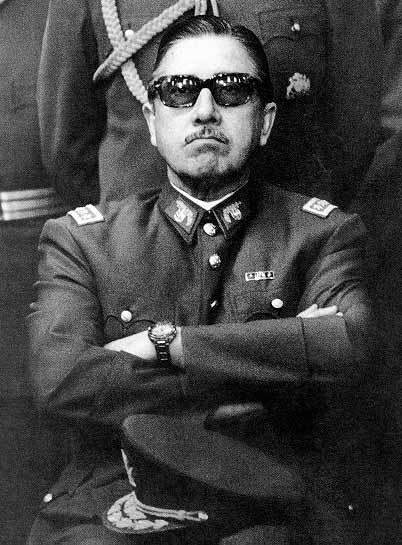
Un cabrón menos, as a friend of ours said.
Update: I heard on the radio this morning that Pinochet was once asked why he always wore sunglasses. His answer was that if you tell a lie and you aren't wearing them, people will spot it. What a card.

Names
November 16, 2006
That exciting body, Spain's National Statistics Institute, has just published a list of the most common names of Spain's residents, as well as lists showing how those names are distributed across Spain. Surprisingly, only 3.15% of women are called María, but the number shoots up to 28.5% if you include nombres compuestos such as María José. Meanwhile, 13.7% of men in Spain (most of whom are Spanish men) have José somewhere in their name. In Ceuta and Melilla, meanwhile, the most common name is Mohamed. And I'm pleased to report that in its article on the subject, El País saw fit to point out the surprising (to me) fact that 0.14% of the residents of Spain have Jonathan as part of their name. Pretty impressive, when you think that Cesár, that most Spanish of names, stands at only 0.19%.
Goya's Bad Luck
November 15, 2006

PdS Blog apologizes for that extended silence.
As anyone with even a passing interest in Spain will be aware, this painting, Goya's Niños del carretón (Children with a Cart) has been carted away by a thief on its way from Toledo, Ohio to the Guggenheim. (It has actually been stolen once before, in 1870). Meanwhile, blog readers might be interested in seeing this film by Milos Forman, who also made one of my (and many people's) favorite films, One Flew over the Cuckoo's Nest. I personally wasn't overimpressed (particularly by Javier Bardem's English), but the visuals are marvelous, and Stellan Skarsgard makes a memorable Goya, even though the film makes no attempt whatever to inquire into the sources of his genius (it is not the biopic the title leads you to expect). For that, you have to read this. So far, Goya's Ghosts doesn't have international distribution, so you may have to wait a while to see it.
*Update*, 20th November 2006: they've found it in New Jersey. And someone is $50,000 richer for giving the FBI the lead they needed.
How to Lose Friends and Lose Your Influence over People
July 20, 2006

. Whatever your political beliefs, Prime Ministers should not wear a keffiyeh. I mean, I doubt whether he'd do the same if someone asked him to wear a Barcelona or a Real Madrid scarf. But does wearing it immediately make him anti-Semitic, as interested sections of the press are suggesting? Probably not. An idiot, perhaps, because this surely damages any contribution Spain might have made to possible peace negotiations - but not necessarily an anti-Semitic idiot.
Valencia
July 3, 2006
My wife and children are in the beautiful city of Valencia at the moment, so my heart missed a beat when I heard today's dreadful news. They're fine. The causes of the accident are thought to be speeding, perhaps a broken wheel, and not terrorism, though the thought still flashes through your mind. The number of dead currently stands at 34. Another major tragedy strikes Spain's unlucky rail system. Our hearts go out to families and friends.
They're doing everything they can...
May 7, 2006
...to in Spain. Mass romance: I wonder whether anyone got married, since the registry office stayed open?
Avecrem
April 22, 2006

Avecrem is Spain's best-known brand of stock cube - the Hispanic Oxo cube, if you will. So why has PdS Blog given a 60's ad for Avecrem the honour of appearing at the top of today's post? Simply because, as this article tells us, Avecrem was one of the ingredients used in a soup that was prepared (and eaten?) yesterday in the municipal cemetery of Peralada, in Girona. The other ingredients were the bones of a woman who died 10 years ago - grave robbers opened her tomb, removed the bones, and cooked up a soup with them. The remains of the bones were discovered there earlier today, along with the cooking-pot and the Avecrem. The police are hunting for the gourmets.
And apropos of nothing, but fascinatingly: "Writing should look like nature".
Responses
July 12, 2005
There's a nice Guardian piece here comparing the British and Spanish reactions to their respective tragedies. I link to it only because I. pointed out exactly this last night - how phlegmatic the Brits are about tragedy - and I reckoned it wasn't necessarily such a good thing.
London, July 7th 2005
July 7, 2005
"Life is conceiving the inconceivable."
Unfortunately. This from Forges, in El País.
Two-Thirty
July 6, 2005
"When the doctor writes out a prescription he gives us one last look to check whether we should have cheap or expensive medicine."
A microwave? .
Gossip
May 18, 2005

I was teaching Jean Rhys's Wide Sargasso Sea yesterday and was going on about the importance of gossip in the novel, with its variety of narrators, as a subversive force, as a threat to the voice of authority (from one point of view, what are novels if not just gossip?). And now I see that Ignacio Jimenez, the mayor of Icononzo, in Colombia, agrees. He has banned gossip in Icononzo, telling that "loose tongues can cost lives in Colombia, which is in the grips of a guerrilla war involving Marxist rebels and far-right paramilitary outlaws". Meanwhile, more gossip in the fact that a member of Claude Cassirer's family (see the Pissarro post below) writes from Telluride to PdS Blog thanking us for the "humorous spin on the family's efforts to recover the Pissarro masterpiece stolen by the Nazis from my great-grandmother in 1939." May the best man win. Meanwhile, gossip might lead to very good things here - a once-unimaginable step forward. Will the opportunity be taken?
Highway Clubs: An Introduction
May 11, 2005
You often see them as you zoom past on your way to somewhere else – Spain’s clubes de carretera, often looking like vulgar little mansions, often painted brightly and often with a neon sign, usually lit during the day, that might say simply “CLUB” or, if the owners are more creative types, “JOLY CLUB” or “CLUB VEGAS” or some such thing. There are 1,070 of them dotted around Spain. They often seem to be located in the middle of nowhere, stuck in the middle of an area of desert or with an incongruous mountain sticking up behind them, and often, during the daytime at least, there is a single car or a long-distance truck sitting there forlornly, lost in the huge car park. Anonymity seems to be the key. Inside (apparently), the better ones are cheaply plush, velvet-walled, red-lit, designed in a parody of luxury, but the bar prices are the prices of genuine luxury. An article in yesterday’s El País - based on a poetically-titled report by the , “Tráfico de seres humanos con fines de explotación sexual” - says that there are now 20,000 women working as prostitutes in Spain’s clubes de carretera (19,154, to be exact), about double the number working there five years ago. The vast majority of them are immigrants who have paid for the pleasure, and some have been informed by people trafficking organizations that they would be coming to Spain to work in “respectable” jobs in restaurants or as cleaners or housekeepers. But the report also points out that the word is out on this, and that the days of women being kept against their will as virtual slaves in the clubes de carretera are passing. Nowadays, most of the immigrant women know exactly what it is they are getting into from the word go. (Only 225 women in total took the chance to lodge a formal complaint with the Guardia Civil that they were being sexually exploited during the preparation of the report.) 58.4% of the women are Latin American, 34% European; the highest number are Romanians, of whom there are 3,900. Anybody wanting to get a flavor of what life is like inside a club de carretera could have a look at a couple of films: Juanma Bajo Ulloa’s comedy Airbag, or Bigas Luna’s memorably surreal , in which Penélope Cruz’s fictional mother runs one (that's PC and Javier Bardem under the flying pig in the picture). You get the feeling that there are films to be made and books to be written about what goes on in these places, in the stories that these women are carrying. So the next time you zoom past a club de carretera, have a think about all that.
Highway Clubs: An Introduction
You often see them as you zoom past on your way to somewhere else – Spain’s clubes de carretera, often looking like vulgar little mansions, often painted brightly and often with a neon sign, usually lit during the day, that might say simply “CLUB” or, if the owners are more creative types, “JOLY CLUB” or “CLUB VEGAS” or some such thing. There are 1,070 of them dotted around Spain. They often seem to be located in the middle of nowhere, stuck in the middle of an area of desert or with an incongruous mountain sticking up behind them, and often, during the daytime at least, there is a single car or a long-distance truck sitting there forlornly, lost in the huge car park. Anonymity seems to be the key. Inside (apparently), the better ones are cheaply plush, velvet-walled, red-lit, designed in a parody of luxury, but the bar prices are the prices of genuine luxury. An article in yesterday’s El País - based on a poetically-titled report by the , “Tráfico de seres humanos con fines de explotación sexual” - says that there are now 20,000 women working as prostitutes in Spain’s clubes de carretera (19,154, to be exact), about double the number working there five years ago. The vast majority of them are immigrants who have paid for the pleasure, and some have been informed by people trafficking organizations that they would be coming to Spain to work in “respectable” jobs in restaurants or as cleaners or housekeepers. But the report also points out that the word is out on this, and that the days of women being kept against their will as virtual slaves in the clubes de carretera are passing. Nowadays, most of the immigrant women know exactly what it is they are getting into from the word go. (Only 225 women in total took the chance to lodge a formal complaint with the Guardia Civil that they were being sexually exploited during the preparation of the report.) 58.4% of the women are Latin American, 34% European; the highest number are Romanians, of whom there are 3,900. Anybody wanting to get a flavor of what life is like inside a club de carretera could have a look at a couple of films: Juanma Bajo Ulloa’s comedy Airbag, or Bigas Luna’s memorably surreal , in which Penélope Cruz’s fictional mother runs one (that's PC and Javier Bardem under the flying pig in the picture). You get the feeling that there are films to be made and books to be written about what goes on in these places, in the stories that these women are carrying. So the next time you zoom past a club de carretera, have a think about all that.
The Great Debate
March 15, 2005

Photographed at Atocha railway station, March 12th 2005, the day after the first anniversary of the attacks. "With all Affection from the Islamic Cultural Center of Madrid". Someone has written "I don't believe it", but this has been crossed out: to the left, it says "I DO believe it".
--------
The Importance of Forgetting
February 1, 2005

The Madrid attacks of March 11 2004 are commemorated in a potent documentary film called (We Were All on That Train), which consists of 24 short pieces offering different perspectives on the tragedy. It is showing in only one cinema in the capital, and that cinema is in the barrio of Vallecas, far from the city centre, but close to where one of the trains was blown up. I saw the film at six o'clock tonight - and I was the only person in there. In theory it's good and necessary to remember tragedies - but the thought struck me, as I sat there alone, that perhaps nobody, least of all those close to the victims, actually wants to. See it if you can.
--------
Ramona Maneiro
January 10, 2005

Ramón Sampedro, the tetraplegic whose assisted death is the basis of Alejandro Amenábar's new film Mar adentro (The Sea Inside), died on video drinking a mixture of water and cyanide. So that no one individual would be blamed for the death, an incredible 13,000 people claimed responsibility for what was (and still is) an illegal act in Spain. Now the woman responsible, a close friend of Sampedro's called Ramona Maneiro, also known as "Moncha", has come forward and claimed responsibility for preparing and giving him the drink and for recording the famous video of his final moments, so as to put an end to the speculation. She had previously been accused of the "crime", but was never charged for lack of proof. Sampedro, who evidently paid great attention to the details of his own end, apparently told Maneiro not to kiss him on the lips after he had drunk the lethal concoction.
--------
Just Fine?
December 21, 2004

This is an old image of the popular racist Luis Aragonés, now manager of the Spanish national team, who was probably responsible for starting the chain that ended with thousands of Spaniards making monkey noises at England's black footballers last month. (Aragonés is under enquiry, but there doesn't seem to be much to enquire about since his racist comments about Thierry Henry, made to José Antonio Reyes, were recorded live on video and are there for all to see.) Today FIFA have handed the Spanish FA a fine of 100,000 Swiss francs (about $87,000), which given the sums of money bandied about in soccer and the extent of the racist problem in football here, is bit like smacking Godzilla behind the knees and telling him to be a good boy from now on. I've been looking on the Internet for the fine piece by the mythical football journalist Johnny Doherty about the racist issue, but can't find it anywhere.
More cross-cultural conflict: John Naughton has a nice on the removal of a play in Birmingham following violence by Sikhs offended by it. He quotes the brilliant H.L. Mencken, who just about said it all when he said: "We must respect the other fellow's religion, but only in the sense and to the extent that we respect his theory that his wife is beautiful and his children are smart." There's another little slice of Mencken wit here.
--------
Department of Bovine Security
November 5, 2004
"Following a series of brutal attacks, Spanish Prime Minister José Luis Zapatero pledged Monday that he "will not rest until Spain is free of rampaging bulls." The Onion turns its clever satirical eye on Spain. Very nice. And nice to see the é in José there, too. The English-language press gets its Spanish accents wrong (normally by forgetting them) about as often as the Spanish press gets its spelling of "John" wrong.
--------
Cracking News, That
October 8, 2004
for doctors from Spain going to work in Yorkshire. Well, I'll go to the foot of our stairs.
--------
Very Bad Joke
October 7, 2004
When I was 16, I wrote a miserabilist Elvis Costello-type song that started:
"I've been away for a while, but I don't suppose you noticed..."
Which may be true of PdS Blog. If you're one of those fine people who did notice, then sorry!
The grand old man of Spanish soccer, Luis Aragonés, has made . In the UK recently, former soccer manager Ron Atkinson said something similar when he thought he was off-mike and lost his job as a soccer pundit on the Guardian for it. In Spain, however, reaction has been, as the Yahoo article points out, "muted", with several newspapers rushing to Aragonés's defence, and it's unlikely that anyone will suggest he should stand down as the team's national manager. (Some papers seem to believe, implausibly, he's a kind of messiah of multi-culturalism.) The famously grumpy Aragonés is known here as the "wise man of Hortaleza", and it seems he's wise enough to know that racist comments that would topple governments in other countries, if the media got hold of them, are unlikely to have any effect whatsoever in Spain. There's no shortage of racism in soccer here, as 20 minutes spent on the terraces at Atlético de Madrid (a team Aragonés has managed several times) will teach you.
Meanwhile, it seems that Brit kids prefer Spanish. (This may be the first and last time that I link to the Leicester Mercury.)
--------
Very Bad Ad
September 16, 2004
A startling ad for El País hits new levels of tastelessness. (via Blogdex.) Guaranteed to ease US/Spain relations still further.
--------
Ethical Journalism and Diet
September 4, 2004
This reads like something written and conceived in a different, better world. The reasons why many of these rules are not followed in this world are two: Time and Money. I speak from experience. But then I suppose another item on the list might be: "A journalist should never worry about time or money, and in fact be superhuman". (Via Anil Dash.)
Perhaps they should try eating better: "UK consumers are [...] more likely than their European counterparts to miss breakfast: in 2003, British skipped on average 113 breakfasts a year per person, and Datamonitor forecasts this will increase to almost 120 in 2008. In comparison, the French skipped 77 and Germans 72, while the southern Europeans in Italy (41) and Spain (31) appear to be clinging more tightly to traditional eating patterns." (Look at the photo from two posts ago to see some Spaniards clinging to a traditional eating pattern.) Is breakfast slowly disappearing, then? Is it the eternal hasta luego to ? I may be wrong about this, but I'd say I skipped a maximum of ten breakfasts in 2003 - though most of them weren't exactly what you'd call leisurely. Average time: probably about 3 minutes. Ah, the wonderful world of stats. And there's this, too, from the same site.
--------